Research
2022 Frontline Nurse Mental Health & Well-being Survey
For the third year in a row, the Trusted Health team has set out to gauge the mental health & well-being of our nursing workforce. Explore our insights.

INTRO
For the third year in a row, the team at Trusted Health has set out to gauge the mental health and well-being of our nursing workforce as part of our overall mission to support the individuals who make up the backbone of our healthcare system. This year we expanded our focus to better understand the relationship between nurses, their employers and the healthcare industry at large when it comes to helping nurses manage their mental health.
The picture that emerges is worrisome. Nurse mental health has not rebounded to anywhere near its pre-COVID levels, even as we enter a new and less destructive phase of the pandemic. Nurses are continuing to struggle with high levels of burnout, trauma, depression and experience suicidal thoughts at twice the rate of the average American adult, but are reluctant to seek help, both in and outside of work. As was first highlighted in last year’s survey, nurses do not feel supported at the facility level, nor do they feel that the industry’s stance on nurse mental health has evolved, despite widespread attention given to the issue.

We’ve tried as much as possible to focus on solutions in this report, including identifying the specific benefits that nurses would find most valuable, the culture changes that will facilitate discussions around mental health and the perceptions that hospitals and health systems need to address. But one thing is clear: many nurses do not see this as a profession that is compatible with mental health, and swift, decisive action is needed to stem the tide of departures. These departures are likely to increase, given that fully 64% of nurses say they are less committed to the profession than they were pre-pandemic, a 39% increase from our 2021 survey.
The pandemic has revealed the broken nature of many aspects of our healthcare system, but this moment can actually offer a chance to start fresh and rebuild nursing from the ground up to ensure nurses are supported with the right policies and infrastructure that make nursing not only a viable long-term career option but a desirable one. We think that this is an excellent place to start.
METHODOLOGY & DEMOGRAPHICS
The data in this study is gathered from responses from more than 2,500 nurses to an online survey conducted by email in May of 2022.
What is your gender?
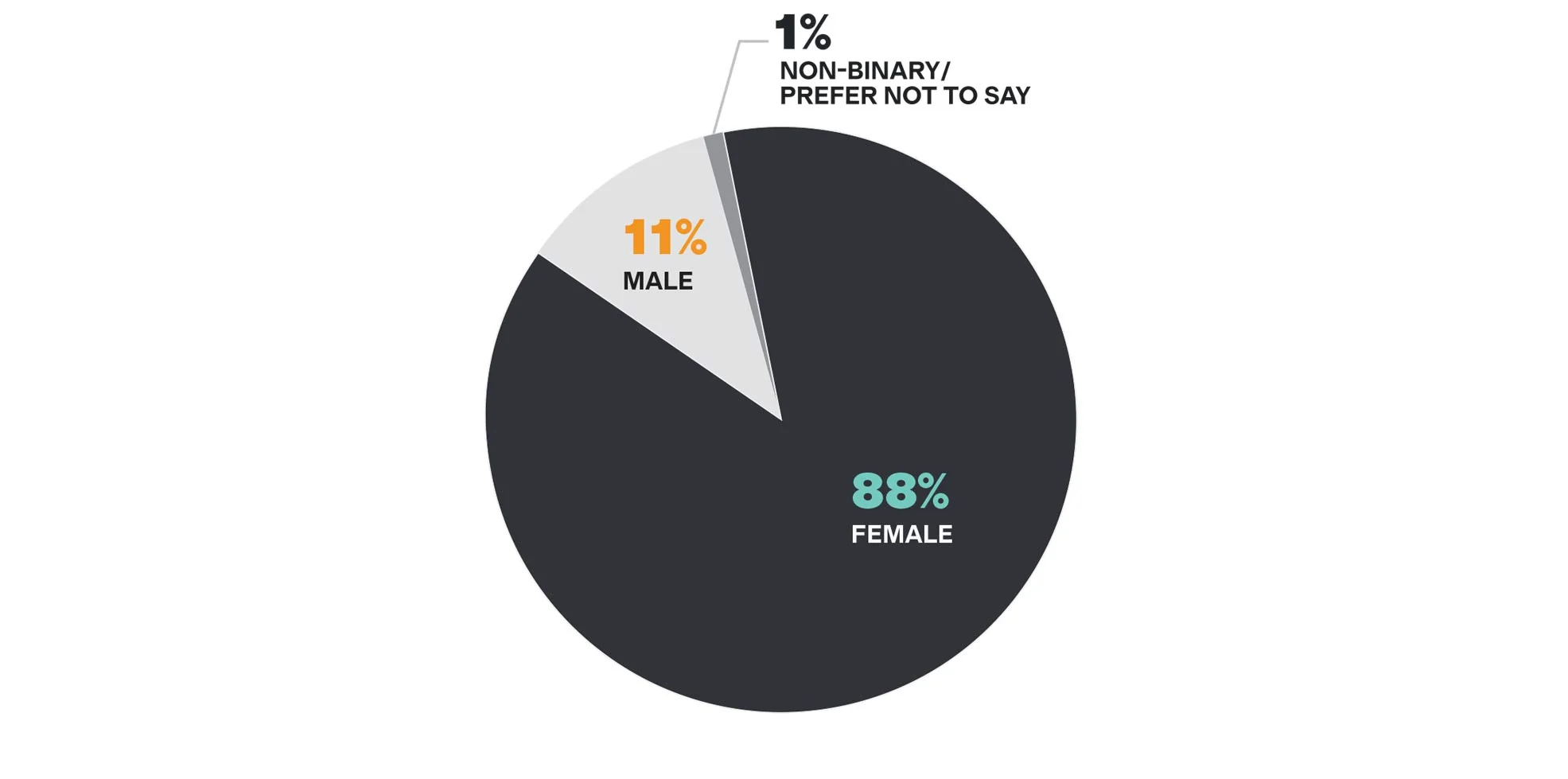 Chart data: 1% · NON-BINARY/ · PREFER NOT TO SAY · 11% · MALE · 88% · FEMALE
What is your age?
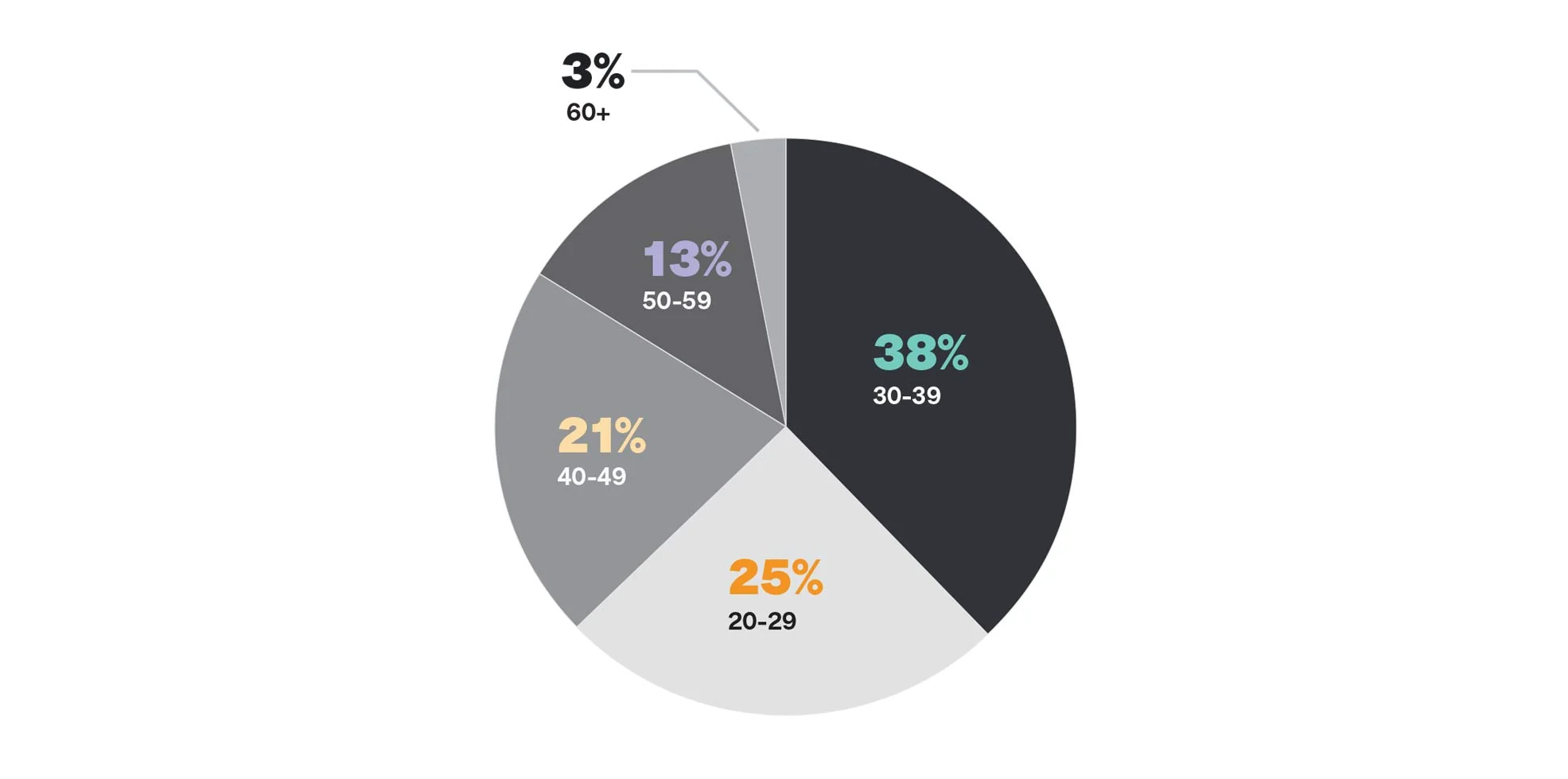 Chart data: 3% · 60+ · 13% · 50-59 · 38% · 30-39 · 21% · 40-49 · 25% · 20-29
What department do you work in?
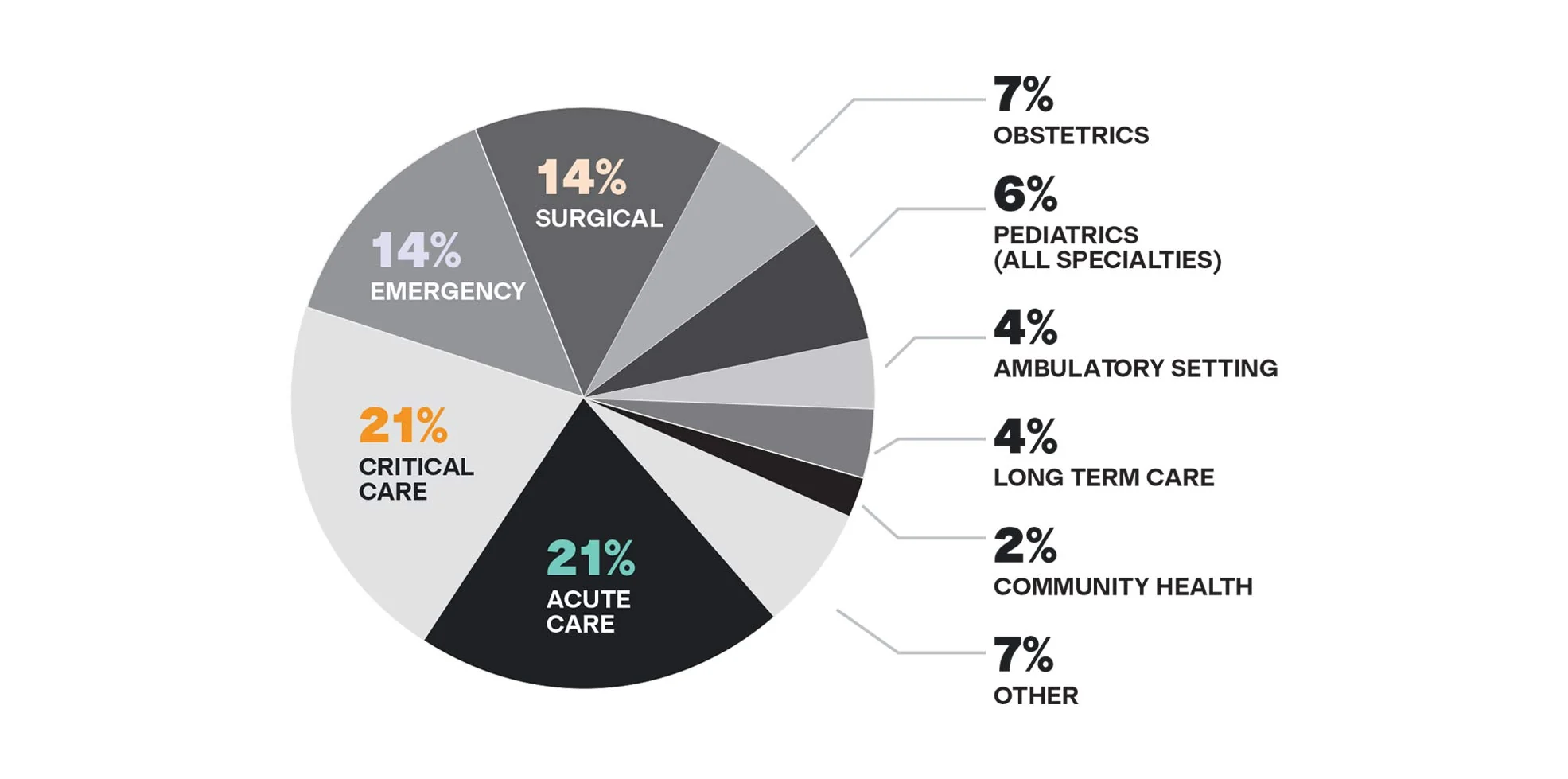 Chart data: 7% · OBSTETRICS · 14% · 6% · SURGICAL · PEDIATRICS · 14% · (ALL SPECIALTIES) · EMERGENCY · 4% · AMBULATORY SETTING · 21% · 4% · CRITICAL · LONG TERM CARE · CARE · 21% · 2% · COMMUNITY HEALTH · ACUTE · CARE · 7% · OTHER
Eighty-eight percent of respondents were female, 11% were male and 1% were either gender non-binary or preferred not to say.
Nearly 40% of respondents were in their thirties, and roughly two-thirds were under the age of 40.
KEY FINDINGS
Nurses’ mental health has not rebounded to its pre-pandemic levels.
On a scale of 1-10, nurses rated their current mental health and well-being at an average of 5.8, compared to an average of 7.8 prior to the COVID-19 crisis, representing a decline of 26%. The findings indicate a very modest improvement over previous years’ studies, which found decreases of 28% and 29% respectively. Still, this finding indicates that nurses’ mental health and well-being have not come close to reaching their pre-COVID levels, even as the most acute phase of the pandemic has subsided.
Please rate your state of mental health.
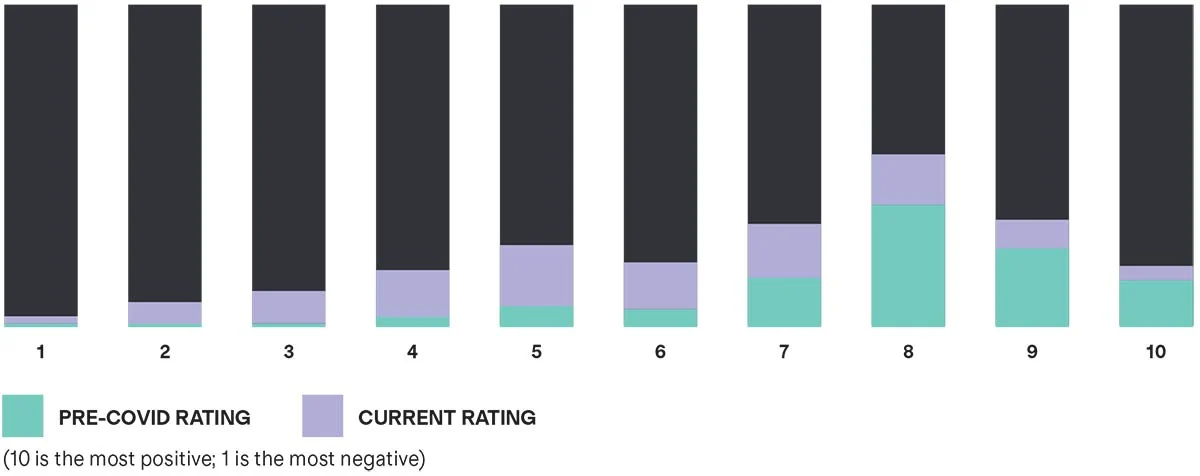 Chart data: 1 · 2 · 3 · 4 · 5 · 6 · 7 · 8 · 9 · 10 · PRE-COVID RATING · CURRENT RATING · (10 is the most positive; 1 is the most negative
One in ten nurses have experienced suicidal thoughts as a result of the pandemic.
Nurses reported a variety of negative outcomes on their physical and mental health as a result of the pandemic, including burnout (75%), compassion fatigue (66%), depression (64%), declines in their physical health (64%) and extreme feelings of trauma, extreme stress and/or PTSD (50%). Half of all nurses also report being the subject of an attack, intimidation or assault by a patient or his or her family, echoing wide-scale reports that violence against healthcare professionals has been on the rise.1 Perhaps most disturbing is that one in ten nurses reported that they had had suicidal thoughts since the start of the pandemic, more than twice the incidence of such thoughts amongst the adult population in the U.S. as a whole.2
Since the COVID-19 pandemic began, which of the following statements apply to you?
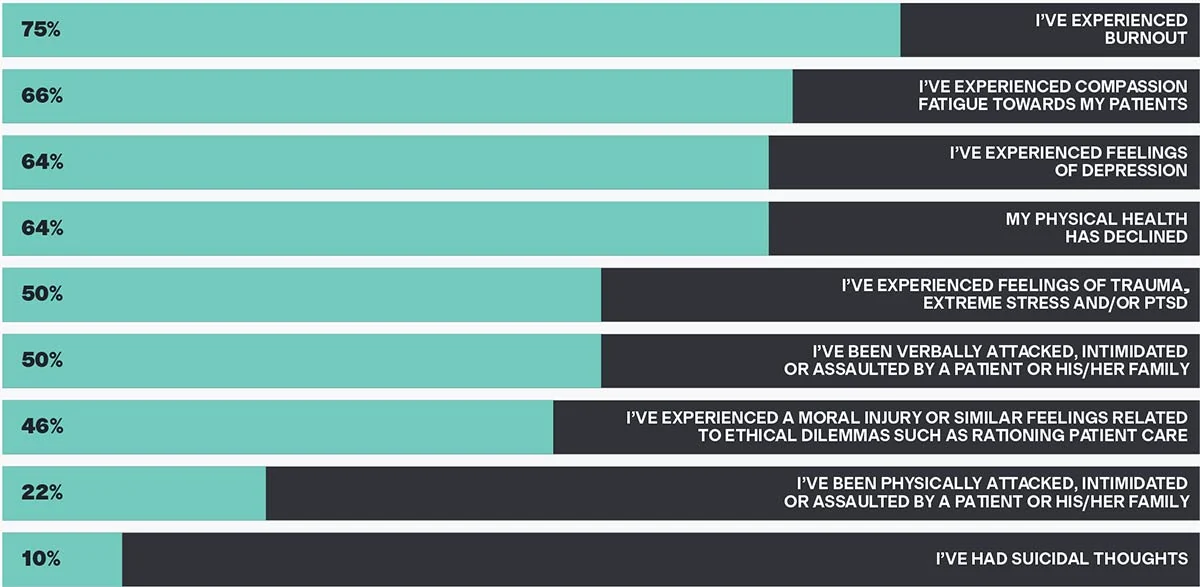 Chart data: 75% · I'VE EXPERIENCED · BURNOUT · I'VE EXPERIENCED COMPASSION · 66% · FATIGUE TOWARDS MY PATIENTS · PVE EXPERIENCED FEELINGS · 64% · OF DEPRESSION · 64% · MY PHYSICAL HEALTH · HAS DECLINED · 50% · I'VE EXPERIENCED FEELINGS OF TRAUMA, · EXTREME STRESS AND/OR PTSD · 50% · 'VE BEEN VERBALLY ATTACKED, INTIMIDATEL · OR ASSAULTED BY A PATIENT OR HIS HER FAMIL · 46% · PVE EXPERIENCED A MORAL INJURY OR SIMILAR FEELINGS RELATED · TO ETHICAL DILEMMAS SUCH AS RATIONING PATIENT CARE · I'VE BEEN PHYSICALLY ATTACKED, INTIMIDATED · 22% · OR ASSAULTED BY A PATIENT OR HIS/HER FAMILY · 10% · I'VE HAD SUICIDAL THOUGHTS
Nearly 40% of nurses don’t know what mental health benefits their current facility offers.
For those who do know, access to a mental health hotline or crisis line (39%); education around mindfulness, meditation or other stress reduction techniques (29%) and one-to-one counseling or therapy (18%) were the most common resources made available by their facility. Notably, none of these resources were among the top three that nurses said they would find most beneficial, which included a wellness or fitness stipend (74%); access to a gym, yoga studio or group fitness classes (67%) and flexible scheduling (64%).
Which of the following benefits does your current facility offer? Which of the following benefits would you find most beneficial?
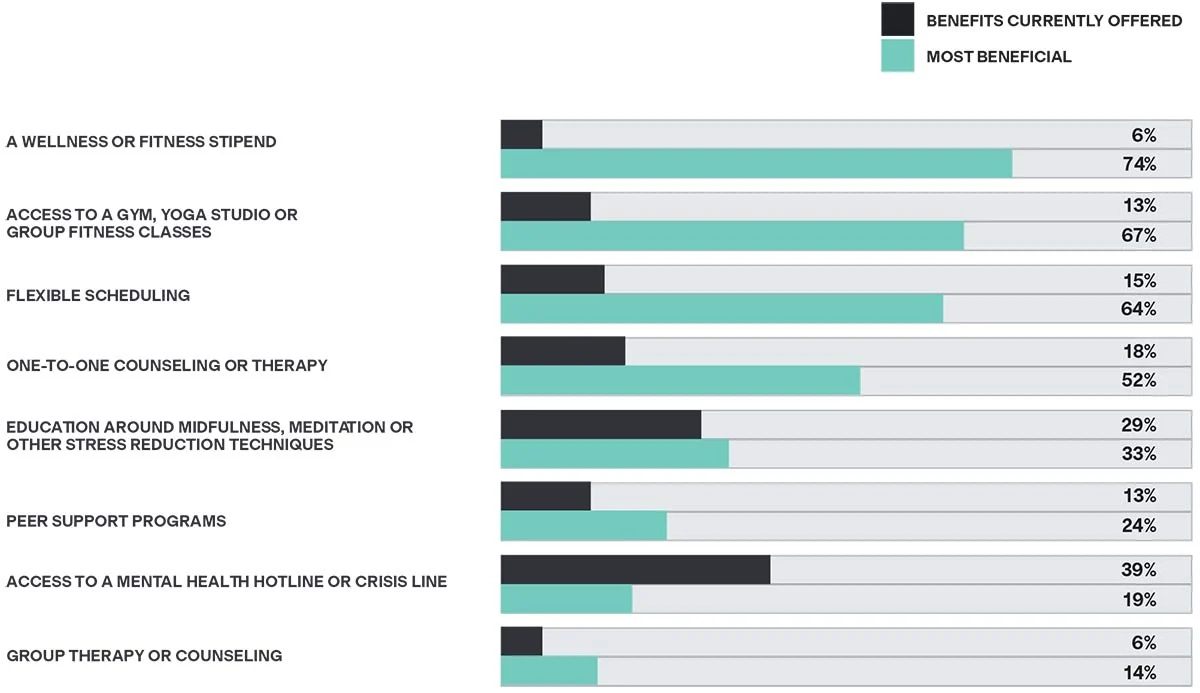 Chart data: BENEFITS CURRENTLY OFFERED · MOST BENEFICIAL · A WELLNESS OR FITNESS STIPEND · 6% · 74% · ACCESS TO A GYM, YOGA STUDIO OR · 13% · GROUP FITNESS CLASSES · 67% · 15% · FLEXIBLE SCHEDULING · 64% · 18% · ONE-TO-ONE COUNSELING OR THERAPY · 52% · EDUCATION AROUND MIDFULNESS, MEDITATION OR · 29% · OTHER STRESS REDUCTION TECHNIQUES · 33% · 13% · PEER SUPPORT PROGRAMS · 24% · 39% · ACCESS TO A MENTAL HEALTH HOTLINE OR CRISIS LINE · 19% · 6% · GROUP THERAPY OR COUNSELING · 14%
More than half of nurses are dissatisfied with the level of support their current facility provides related to their mental health and well-being.
Fifty-three percent of respondents ranked themselves either “somewhat dissatisfied,” “dissatisfied” or “very dissatisfied.”
How satisfied are you with the level of support your current facility provides related to your mental health and well-being?
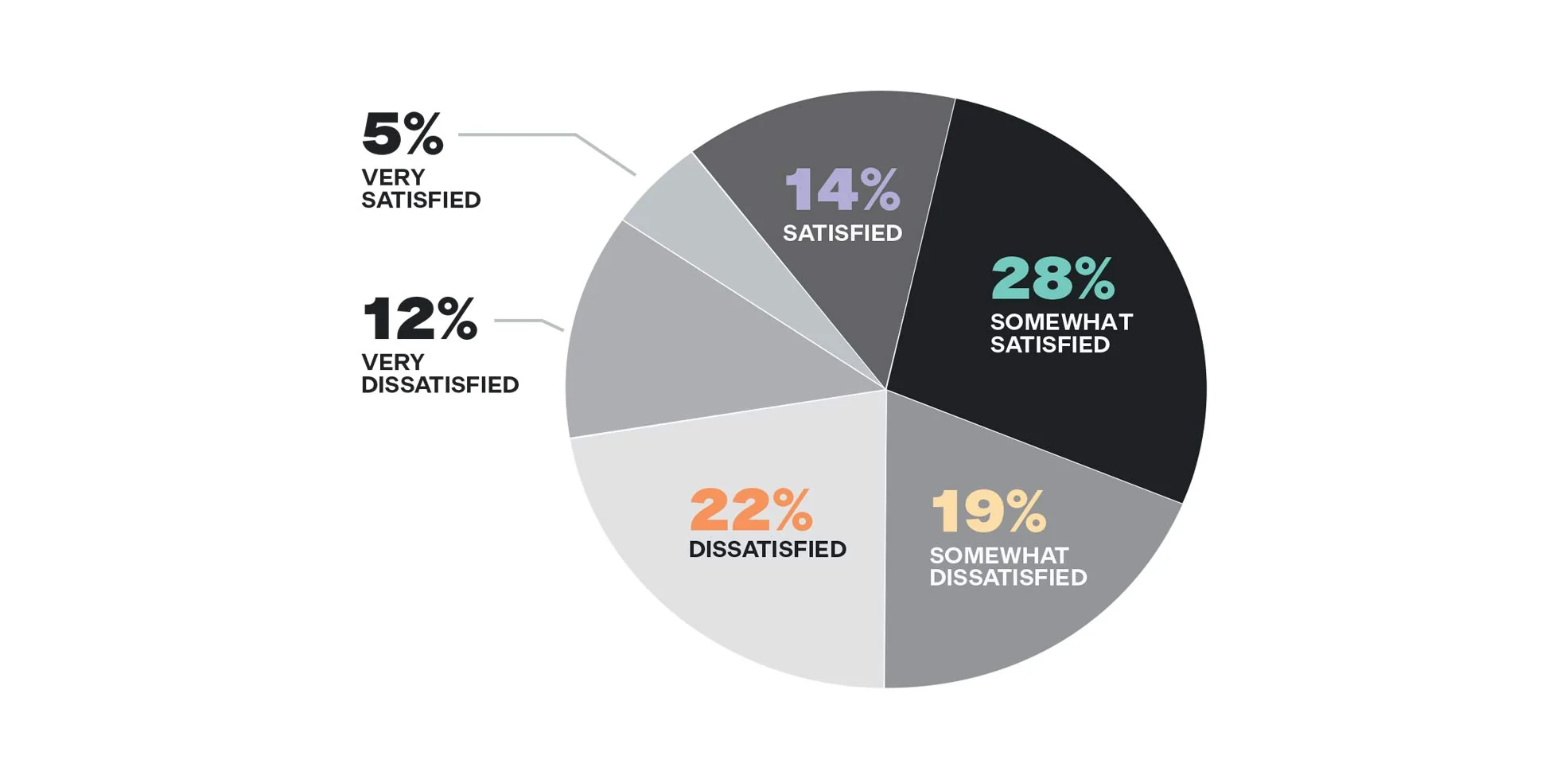 Chart data: 5% · VERY · 14% · SATISFIED · SATISFIED · 28% · 12% · SOMEWHAT · SATISFIED · VERY · DISSATISFIED · 22% · 19% · DISSATISFIED · SOMEWHAT · DISSATISFIED
Nurses are unlikely to seek support at work for mental health issues that could negatively impact their ability to do their jobs.
Nearly 60% of respondents said that they were either “very unlikely” or “somewhat unlikely” to share feelings of acute depression, suicidal thoughts or mental health issues with their manager or another individual at their facility. When asked why, the leading reasons were concerns about confidentiality (72%), job security (69%) and a lack of effort to address the issue (64%). This finding is consistent with previous reports that have found a high degree of stigma around issues of mental health among healthcare workers.³ Nurses were somewhat more likely to seek support outside of work, with 35% reporting that they had sought care from a mental health professional.
If you were experiencing acute depression, suicidal thoughts or mental health issues that you felt could negatively impact your ability to perform your job, how likely would you be to share this with your manager or other individual at your facility?
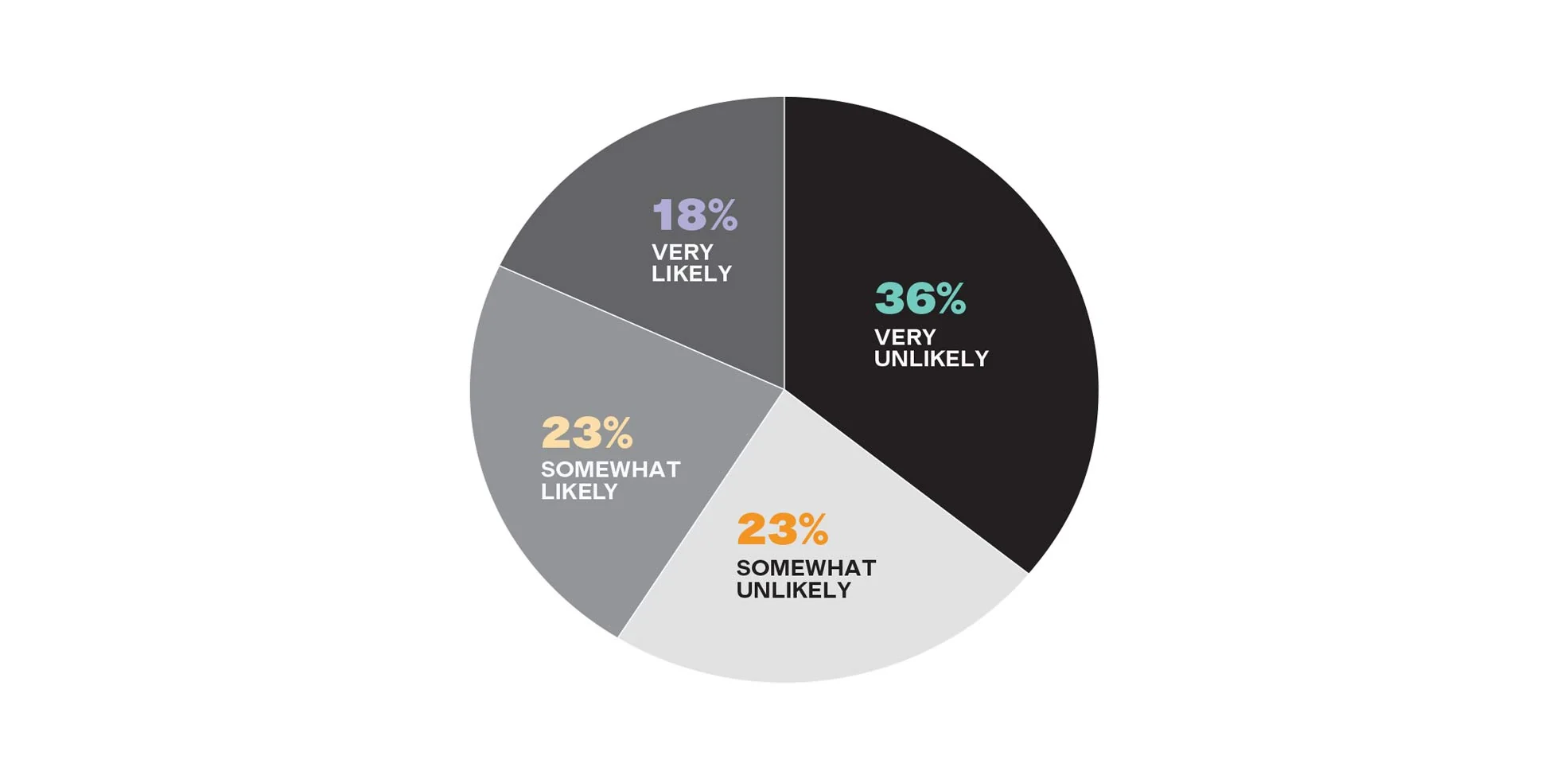 Chart data: 18% · VERY · LIKELY · 36% · VERY · UNLIKELY · 23% · 23% · SOMEWHAT · UNLIKELY
Why would you be unlikely to report these issues?
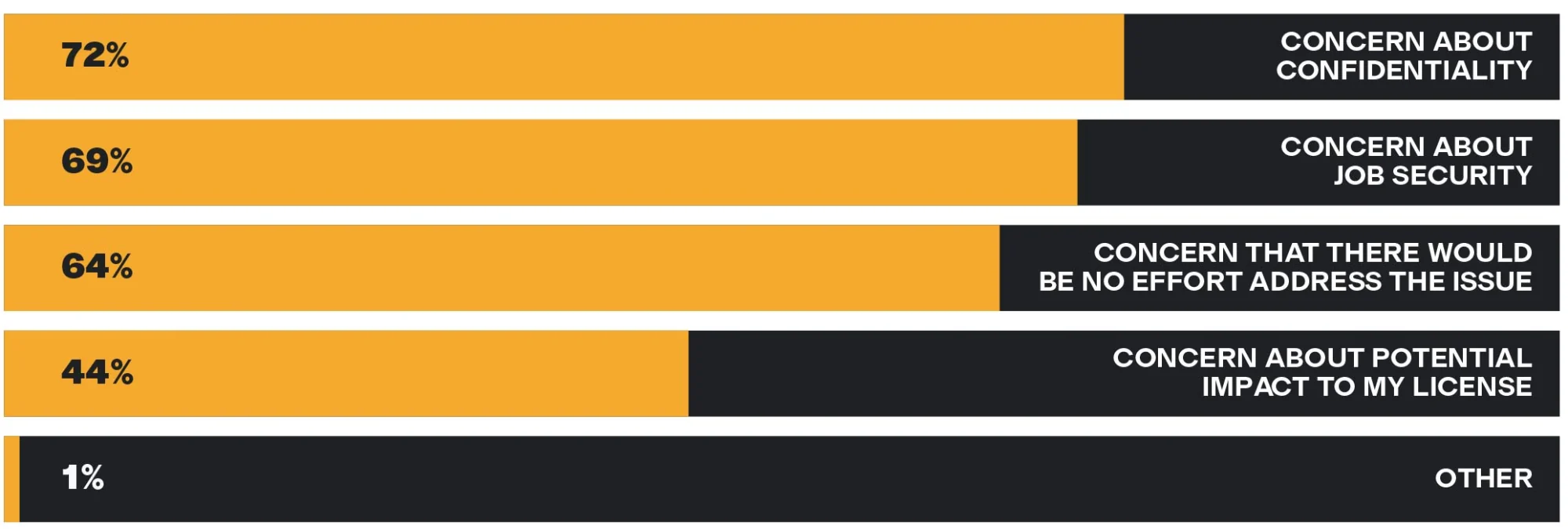 Chart data: CONCERN ABOUT · 72% · CONFIDENTIALITY · CONCERN ABOUT · 69% · JOB SECURITY · CONCERN THAT THERE WOULD · 64% · BE NO EFFORT ADDRESS THE ISSUE · CONCERN ABOUT POTENTIAL · 44% · IMPACT TO MY LICENSE · 1% · OTHER
Have you sought care from a mental health professional like a therapist, psychologist, or psychiatrist?
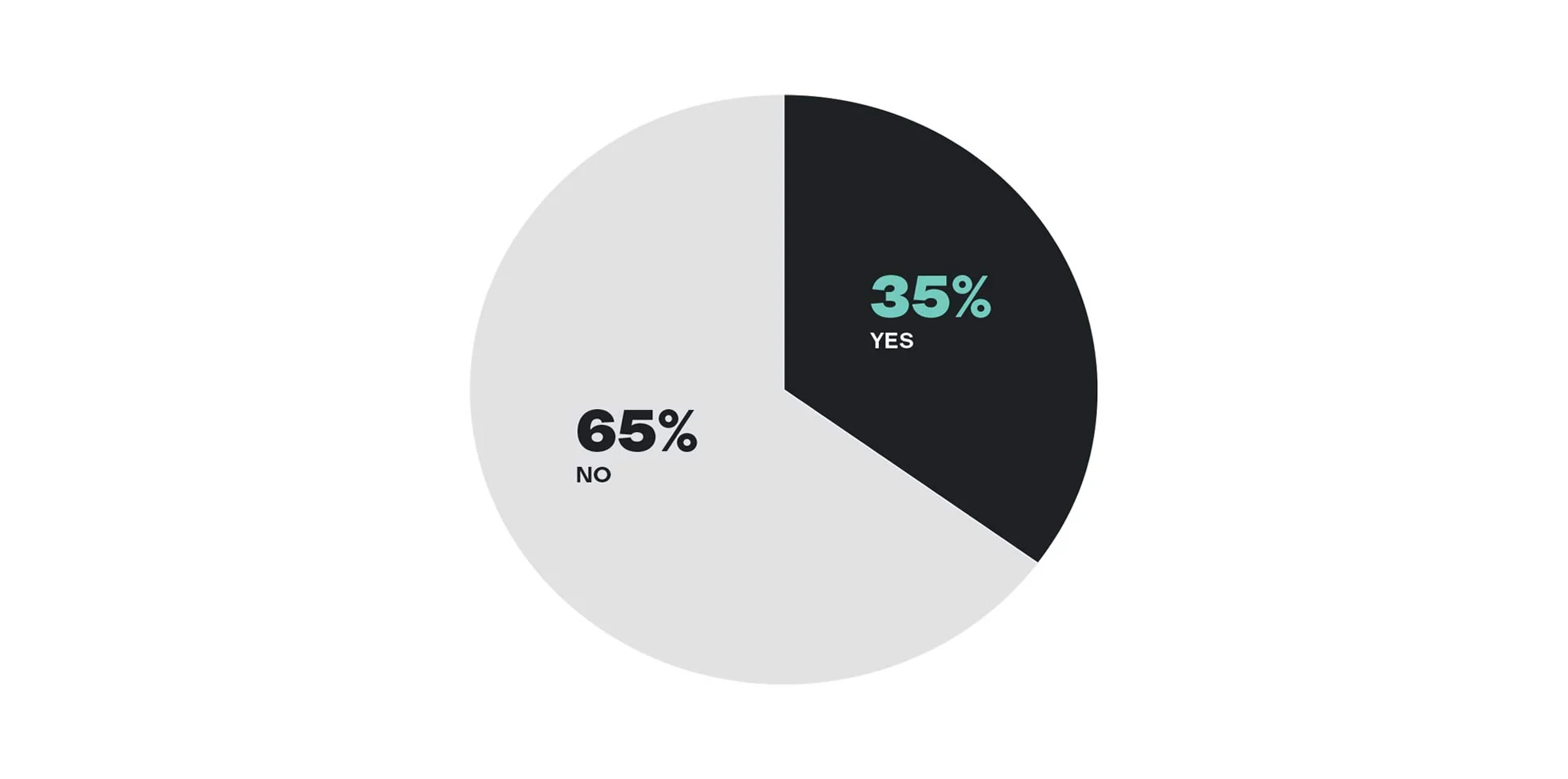 Chart data: 35% · YES · 65% · NO
Despite widespread attention paid to the issue of clinician mental health over the last few years, the majority of nurses feel that the industry’s stance hasn’t evolved.
Consistent with our surveys from 2020 and 2021, the majority of nurses feel unsupported at the systemic level when it comes to their mental health. Two-thirds said that the healthcare industry's stance on nurse mental health has not changed since the start of the pandemic and an overwhelming 95% said that their mental health was either not a priority or that it was a priority, but that there were inadequate measures in place to support it.
How well do you think the healthcare industry prioritizes and supports nurses’ mental health and well-being?
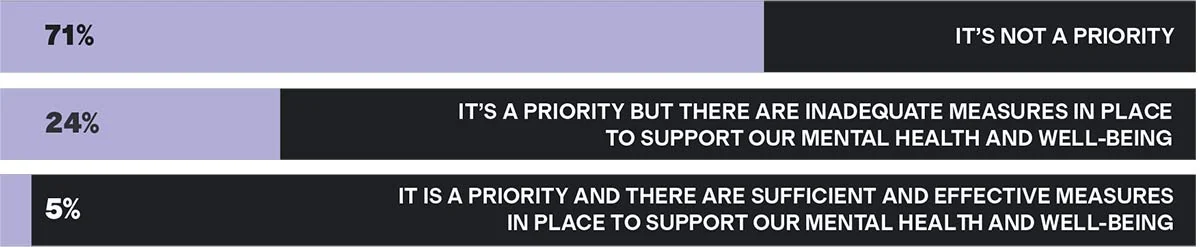 Chart data: 71% · IT'S NOT A PRIORITY · IT'S A PRIORITY BUT THERE ARE INADEQUATE MEASURES IN PLACE · 24% · TO SUPPORT OUR MENTAL HEALTH AND WELL-BEING · IT IS A PRIORITY AND THERE ARE SUFFICIENT AND EFFECTIVE MEASURES · 5% · IN PLACE TO SUPPORT OUR MENTAL HEALTH AND WELL-BEING
How do you think that the healthcare industry’s stance on nurse mental health has evolved since the start of the pandemic?
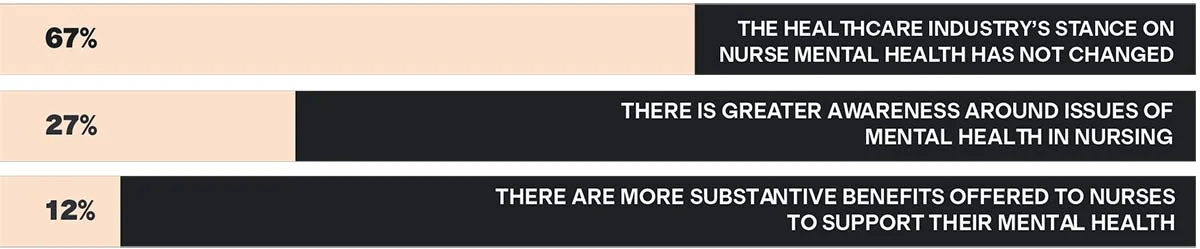 Chart data: THE HEALTHCARE INDUSTRY'S STANCE ON · 67% · NURSE MENTAL HEALTH HAS NOT CHANGED · THERE IS GREATER AWARENESS AROUND ISSUES OF · 27% · MENTAL HEALTH IN NURSING · THERE ARE MORE SUBSTANTIVE BENEFITS OFFERED TO NURSES · 12% м · TO SUPPORT THEIR MENTAL HEALTH
The number of nurses who said that their commitment to the profession has decreased has skyrocketed.
The percentage of nurses who report that they are less committed to nursing as a result of the COVID-19 pandemic jumped from 46% in 2021 to 64% in 2022, an increase of 39%. This was particularly pronounced among nurses ages 20-29 (72%) and 30-39 (69%).
How has the COVID-19 pandemic affected your commitment to nursing?
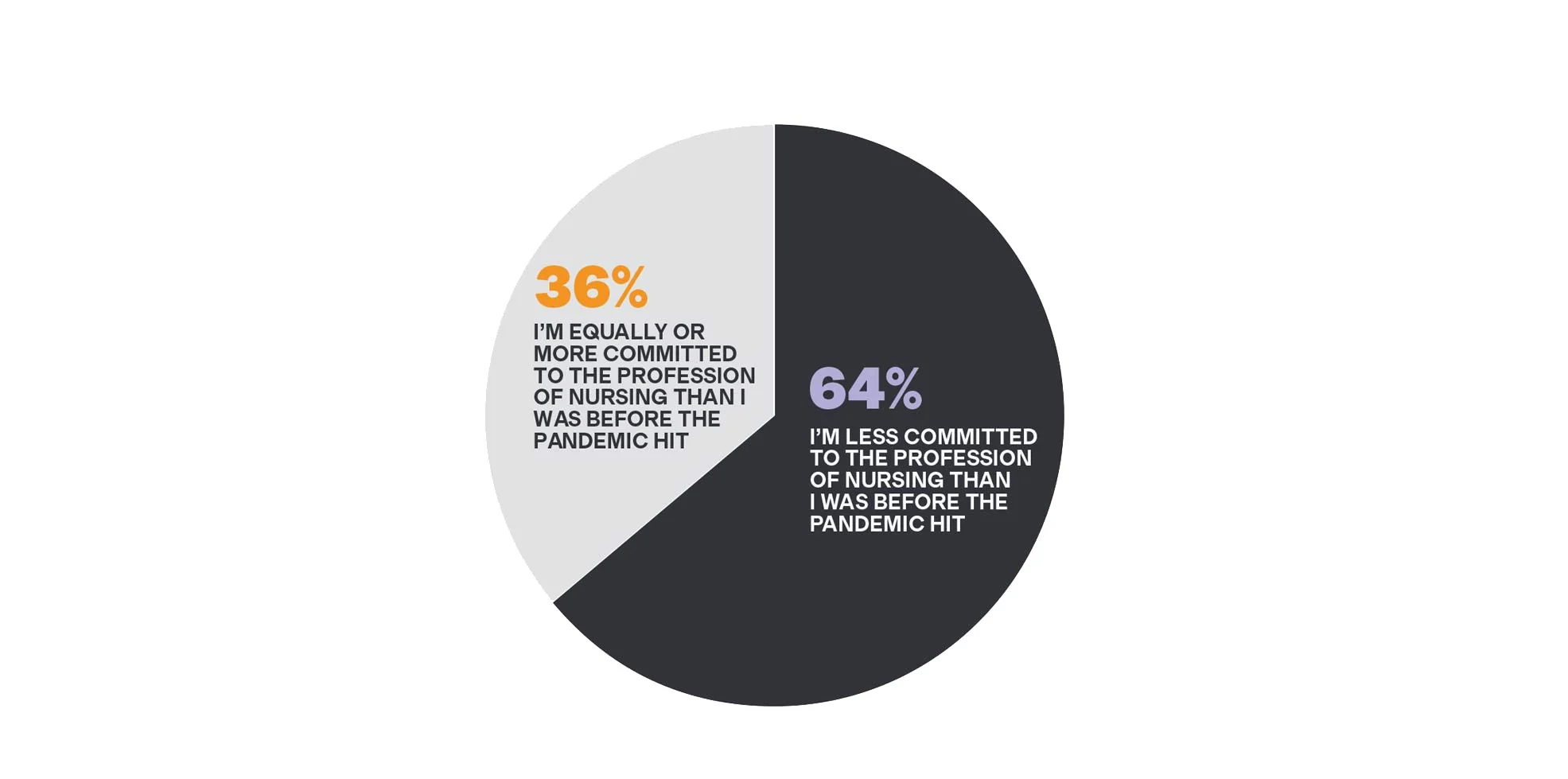 Chart data: 36% · I'M EQUALLY OR · MORE COMMITTED · TO THE PROFESSION · 64% · OF NURSING THAN I · I'M LESS COMMITTED · TO THE PROFESSION · OF NURSING THAN · I WAS BEFORE THE · PANDEMIC HIT
When asked about their future career plans, 58% of all respondents reported that they were either actively looking for a job away from the bedside or outside of nursing completely, had plans to do so within the next year or were planning to retire from the workforce entirely.
What are your future career plans?
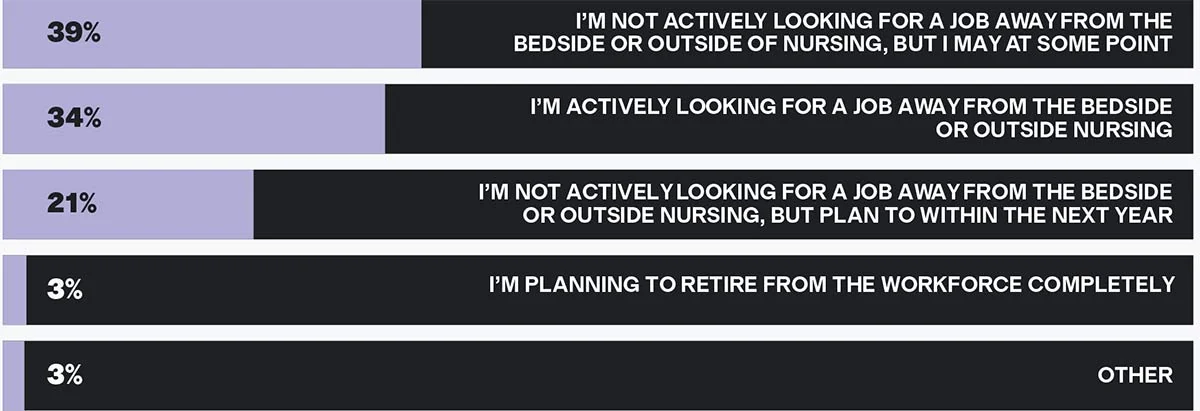 Chart data: I'M NOT ACTIVELY LOOKING FOR A JOB AWAY FROM THE · 39% · BEDSIDE OR OUTSIDE OF NURSING, BUT I MAY AT SOME POINT · I'M ACTIVELY LOOKING FOR A JOB AWAY FROM THE BEDSIDE · 34% · OR OUTSIDE NURSING · 21% · *M NOT ACTIVELY LOOKING FOR A JOB AWAY FROM THE BEDSIDE · OR OUTSIDE NURSING, BUT PLAN TO WITHIN THE NEXT YEAR · 3% · I'M PLANNING TO RETIRE FROM THE WORKFORCE COMPLETELY · 3% · OTHER
When asked what about their current role kept them committed to nursing, compensation was the top response (49%), followed by commitment to patients (26%).
What about your current situation or role is keeping you committed to nursing?
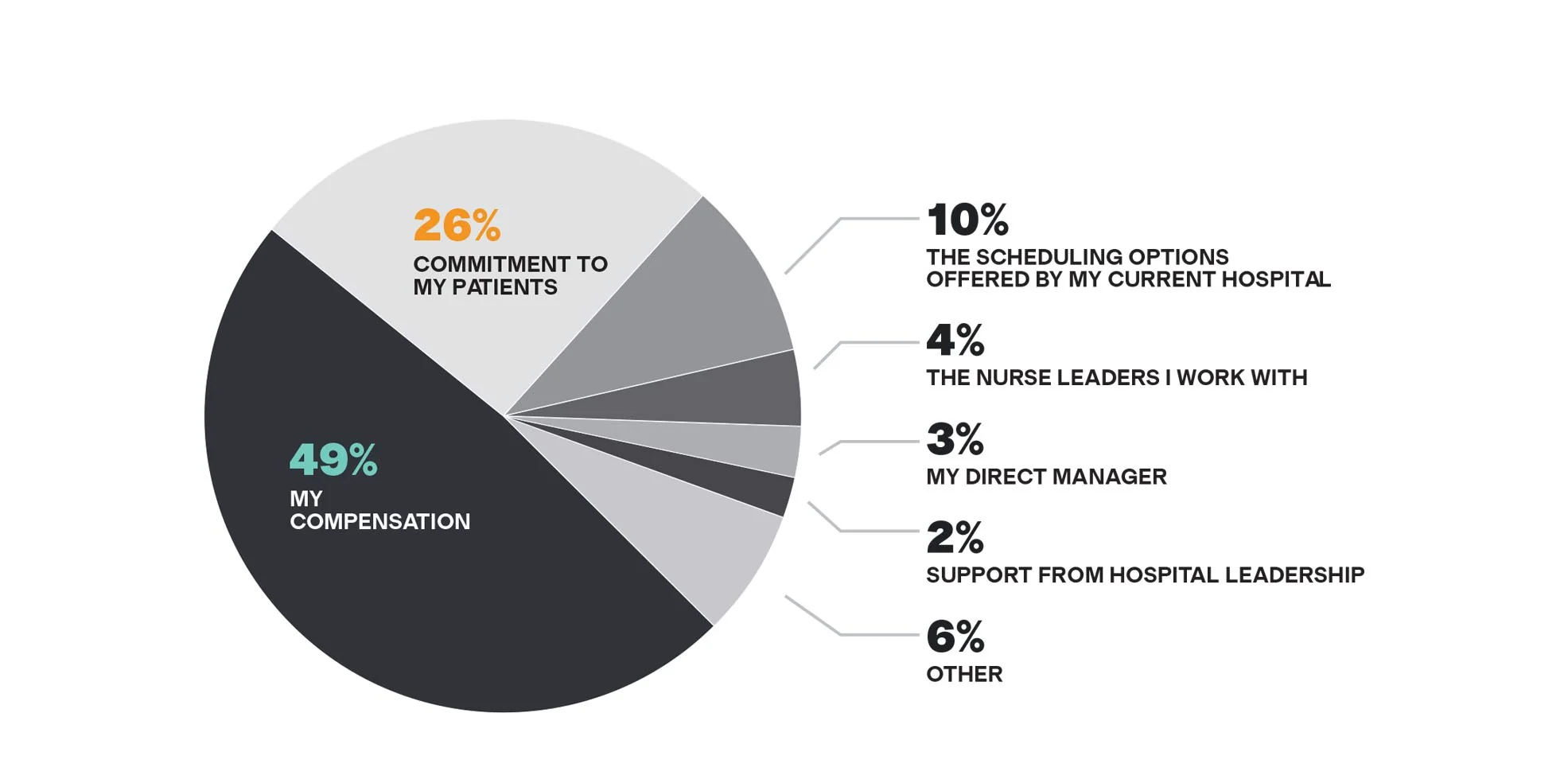 Chart data: 26% · 10% · COMMITMENT TO · THERE NOT SPITAL · MY PATIENTS · 4% · THE NURSE LEADERS I WORK WITH · 3% · 49% · MY DIRECT MANAGER · MY · COMPENSATION · 2% · SUPPORT FROM HOSPITAL LEADERSHIP · 6% · OTHER
RECOMMENDATIONS
Focus on benefits that make nursing a more sustainable career choice.
As COVID-19 transitions from a pandemic to an endemic phase, the stresses that nurses face on the job are shifting and so must the mental health and wellness benefits that we offer them. Substantive mental health programs like crisis hotlines, one-to-one counseling and therapy were critical during the pandemic’s peaks, and will continue to be so for nurses in periods of acute dis-tress. However, this year’s respondents have made it clear that they want benefits that support their physical and mental well-be-ing over the long-term: access to fitness facilities and/or classes, wellness stipends and flexible scheduling. The desire for new and innovative scheduling options echoes previous Trusted research, which found that nearly three-quarters of nurses (71%) say their experience as a nurse would improve if they had more control over their schedule, and more than half (52%) say that the way scheduling is done currently lowers their job satisfaction. As nurses see their peers in other highly skilled industries adopt new ways of working like flexible hours, a four-day work week and remote work, hospitals and health systems will need to find ways to offer them the same.
Destigmatize mental health issues.
Even given the well-documented issues around stigmatization of mental health within the healthcare industry, the fact that only one in three nurses have sought care from a mental health professional and 60% wouldn’t disclose potential job-impairing issues to their employer despite high levels of depression, trauma, stress and suicidal thoughts is disquieting. Hospitals and health systems need to create a culture in which nurses feel comfortable being open and honest about the issues they are facing, particularly when those struggles are a direct result of the demands of the job. When mental health programs are marketed internally – which also needs to be a point of investment given the widespread lack of awareness of available options – it should be packaged with strong messaging around confidentiality and job and license security.
Move from transactional to transformational engagement.
The fact that compensation – rather than their relationship with their managers or facility leadership – is keeping the vast majority of nurses on the job points to a weak, transactional relationship between nurses and their employers. And it’s no wonder: studies have found that the average nurse manager has between 85-90 direct reports, leaving little time for mentorship, rapport building or creating the kind of psychological safety that would be necessary for nurses to come forward with concerns about their mental health.⁴ This relationship is ripe for an overhaul in most organizations, particularly given its importance in nurse satisfaction and retention.⁵ Hospitals need to better train their nurse managers, find ways to free them from the tedium of tasks like staffing and scheduling and help equip them to lead from a place of transformation, rather than of transaction. This includes encouraging and facilitating substantive discussions about a nurse’s career aspirations, well-being and contribution to the larger profession, rather than simply compensation, scheduling and day-to-day tasks.
- “Spat at, abused, attacked: healthcare staff face rising violence during Covid,” Sarah Johnson, The Guardian. June 7, 2021:
https://www.theguardian.com/global-development/2021/jun/07/spat-at-abused-attacked-healthcare-staff-face-rising-violence-during-covid - “Suicidal Thoughts and Behaviors Among Adults Aged ≥18 Years — United States, 2015–2019,” Centers for Disease Control & Prevention. January 2022: https://www.cdc.gov/mmwr/volumes/71/ss/ss7101a1.htm
- “It Is Time To Stop Stigmatizing Mental Health Among Healthcare Workers,” Jessica Gold, Forbes. July 13, 2020:
https://www.forbes.com/sites/jessicagold/2020/07/13/it-is-time-to-stop-stigmatizing-mental-health-among-healthcare-workers/?sh=7372fb717709 - Solutions for the Modern Nurse Manager, Laudio Whitepaper. April 2020:
https://www.laudio.com/wp-content/uploads/2020/04/White-Paper-Laudio-Solutions-for-the-Modern-Nurse-Manager.pdf - “The Nurse Leader’s Pivotal Role in Retaining Millennial Nurses,” Kate Ulep, JONA: The Journal of Nursing Administration. December 2018:
https://journals.lww.com/jonajournal/Abstract/2018/12000/The_Nurse_Leader_s_Pivotal_Role_in_Retaining.7.aspx
“The Relationship Between Effective Nurse Managers and Nursing Retention,” Mary VanOyen Force, JONA: The Journal of Nursing Administration. July 2005: https://journals.lww.com/jonajournal/Abstract/2005/07000/The_Relationship_Between_Effective_Nurse_Managers.5.aspx